Are you decorating a large tree in your living room? Is your mouth watering at the thought of a turkey dinner? It must be Christmas!
Have you ever wondered where some of the UK’s most popular Christmas traditions actually come from?
Here, we take a look at some of the most common traditions and discover their origins.
Easy As Hack
Before you remove your Christmas decorations, take a photo of this year’s setup. It’ll save you time next year deciding where things go, help you spot what’s missing, and make it easier to recreate the magic (or improve on it) year after year.
At a glance
Make your Christmas traditions more meaningful this year:
- Involve the family – delegate decorating tasks age-appropriately
- Start a tradition – buy one new Christmas bauble each year
- Make your decorations – it’s more sustainable and it’s fun
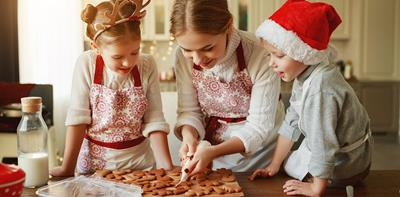
- Bake together – get the children making gingerbread figures
- Tour your area – mark each light display out of 10
CHRISTMAS DAY BEING CELEBRATED ON 25th DECEMBER
It’s one of the most familiar traditions of the season, yet the reason behind the date isn’t entirely clear. Historians still debate its origins. Some suggest it was originally chosen to align with earlier pre-Christian winter festivals that marked the solstice, blending cultural and seasonal significance.
The first recorded celebration of Christmas marking the birth of Jesus on 25th December dates back to Rome in 336 AD1. Over time, the date became a meaningful moment for people across the world, whether rooted in faith, family, or simply the joy of coming together. Whatever the reason, it’s a day that continues to bring warmth, connection, and festive cheer to millions.
Driving somewhere this Christmas? See our top tips for Christmas driving.
A CHRISTMAS TREE
Christmas is the only time of the year when you manoeuvre the most enormous tree possible into your front room, spend hours decorating it and then a few weeks later wave it goodbye.
Here in the UK, the origins of the Christmas tree and its popularity are actually rooted in Germanic heritage. In 1800, Queen Charlotte, the wife of King George III, ordered a yew tree to be brought to the Queen’s Lodge in Windsor. As would have happened in her native Germany, she then decorated it herself.2
Christmas trees did not become a must-have festive feature until the Illustrated London News published a drawing in the 1840s of Queen Victoria and her consort, Prince Albert, also of German descent, decorating their Christmas tree.
We’ve replaced the real candles the Victorians used to decorate their trees with electric lights that look just as pretty and are much safer. However, Christmas trees can still prove a hazard around the house leading to a spike in house fires, one of the common Christmas insurance claims.
TURKEY and Christmas pudding
Fasting used to precede Christmas Day in the Christian calendar,3 so it’s no surprise that many tasty treats have become popular over time as people have sought ways to satisfy their appetites.
A turkey is the traditional centrepiece of a UK Christmas dinner. But why? King Henry VIII is said to be partly responsible, having chosen the bird over a goose for a 16th-century royal Christmas feast.4 Three centuries later, in 1861, Mrs Beeton’s Book of Household Management praised turkey as the Christmas meal for the growing middle classes. Still, it wasn’t until after World War II, when farming became more efficient and food cheaper, that turkey became the traditional Christmas meal in the UK, rather than beef or goose.5
The origins of Christmas (or plum) pudding lie with a 14th-century porridge called ‘frumenty’, which they made with beef and mutton, raisins, currants, prunes, wine, and spices. This recipe slowly evolved into a pudding containing various dried fruits. Banned by the Puritans in the 1640s, it was reintroduced as part of the Christmas meal by King George I at the start of the 18th century.
PULLING CHRISTMAS CRACKERS
A small bang, bad jokes, paper hats and some naff knick-knacks – that’s a Christmas cracker for you. But why do we have them?
Some say an enterprising London-based sweet maker, Tom Smith, first created what would become the Christmas cracker in the mid-19th century. He wrapped sweets in a twist of paper and added a small love motto inside the wrapper.6
Next came the bang, which, so the story goes, the ever-inventive Tom was inspired to add as he listened to the sounds of a crackling log fire. Smith patented his first cracker device in 1847 and perfected the mechanism in the 1860s. It used two narrow strips of paper layered together, with silver fulminate painted on one side and an abrasive surface on the other – when pulled, friction created a small explosion.
Tom then replaced the sweets with toys and later, his son Walter added the final, now-traditional touch when he introduced hats into crackers.
ROYAL CHRISTMAS MESSAGE
Watching TV, especially while trying to digest the Christmas feast, is another popular Christmas tradition – and the King’s Christmas message was still the third most viewed show last year with an audience of 6.8 million people.7
However, this is no surprise, as a royal Christmas Day message has been issued for nearly 100 years now. King George V delivered the first over the radio in 1932 after Prime Minister Ramsay MacDonald had persuaded him that it would foster a sense of community and cohesion throughout the Commonwealth.8
In a speech written by Rudyard Kipling, he started by saying: “Through one of the marvels of modern science, I am enabled, this Christmas Day, to speak to all my peoples throughout the Empire.”
The King initially intended it to be a one-off speech but was so touched by the number of telegrams and letters congratulating him that he decided it should become an annual event.
CAROL SINGING
Carol singing has its roots in pagan winter solstice celebrations and developed into a Christian tradition in medieval times, probably in European monasteries.9
The songs were initially in Latin but began to be sung in regional languages when St Francis of Assisi encouraged people in Italy to sing songs about the Nativity. The idea spread, and by 1426, Christmas carols in English had begun to appear.
Unfortunately, in the UK, the Puritans didn’t like carol singing any more than they liked Christmas puddings! Although they banned carols, people still sang them secretly. It was the Victorians who reintroduced the tradition, popularised by the publication of several books containing carol tunes and lyrics.
Today, singing at the door has, for the most part, died out. However, it’s still not unusual for people to participate in this joyous Christmas tradition in organised services in churches or in choirs in shopping centres and towns, where they often raise money for charity.
BOXING DAY
People from outside the UK and some Commonwealth countries are bemused by our Boxing Day tradition. Is there a big boxing match? Or is Boxing Day something to do with spending the time after Christmas Day boxing up your presents?
The answer is neither of those – instead, its origins can be tracked back to the 19th century, when masters gave servants a rare day off on 26 December and presented them with a special Christmas box. The servants would also go home on Boxing Day to give Christmas boxes to their families.
However, the tradition may also have roots that extend deeper into history. Some historians link it back to alms boxes that were once placed in churches for the collection of donations to aid the poor. Nowadays, it’s both a bank holiday and a public holiday, often associated with discount shopping and sporting events.
Looking for something to do on Boxing Day? Put your festive knowledge to the test with our mini Christmas quiz.
PERSONAL CHRISTMAS TRADITIONS
Many families create their own Christmas traditions, adding and adapting them over the years. How many of us can remember how the tradition started?
Some people have a special breakfast before opening presents in the morning, while others wait until after Christmas lunch or dinner. We’ve also heard of families giving gifts in age order (should grannies and grandpas go first or last?).
Then, some traditions keep the fun going, such as adding little gifts to open at the table, hanging tiny presents from the tree to open after the King’s speech, or settling down to a Christmas movie marathon.
Why not start a family Christmas tradition yourself?
1 https://theconversation.com/celebrating-christmas-on-december-25-began-as-early-as-2-century-ce-history-shows-218928
2 https://www.english-heritage.org.uk/christmas/victorian-christmas-traditions/
3 https://www.learnreligions.com/when-does-the-christmas-season-start-3977659
4 https://www.wiltshirefarmfoods.com/blog/why-do-we-eat-turkey-at-christmas
5 https://www.whychristmas.com/customs/turkeys
6 https://www.vam.ac.uk/articles/the-christmas-cracker
7 https://www.bbc.co.uk/news/articles/c86wy4ev7g3o
8 https://sandringhamestate.co.uk/the-first-christmas-broadcast/
9 https://www.plymouth.ac.uk/discover/the-history-of-christmas-carols